
Lowest and Highest Body Fat Percentage Ever Recorded
From bodybuilders who pushed their bodies to near 0% to the heaviest people ever recorded. The science behind these extremes and why both ends of the spectrum are dangerous.
The Lowest Body Fat Percentage Ever Recorded
Austrian bodybuilder Andreas Munzer is widely cited as having the lowest body fat percentage ever documented. His autopsy in 1996 revealed an extremely muscular physique with almost no visible subcutaneous fat[1]. While some sources claim he reached 0% body fat, that is physiologically impossible. His actual body fat was likely in the range of 1-3%, well below the essential fat threshold needed to survive.
Munzer died at age 31 from multi-organ failure. His autopsy revealed severe liver and kidney damage, likely caused by the combination of extreme dieting, diuretic use, and other substances he used to maintain his conditioning[1]. His case remains one of the most extreme examples of the dangers of pursuing extremely low body fat.
Notable Low Body Fat Records
| Person | Estimated BF% | Context |
|---|---|---|
| Andreas Munzer | ~0-3% | Autopsy after death (1996). Nearly zero subcutaneous fat. |
| Helmut Strebl | ~3-4% | Competition conditioning. Known as "most shredded man alive." |
| Guk Young Lee | <4% | World record: sub-4% for 100+ days naturally (2018). |
| Contest bodybuilders | 3-5% | Typical competition day range. Maintained for hours to days. |
| Fitness models | 6-9% | Photoshoot conditioning. Maintained for days to weeks. |
Longest Time at Extremely Low Body Fat
South Korean fitness model Guk Young Lee holds a world record recognized by the Academy of World Records for maintaining sub-4% body fat for over 100 days naturally, without performance-enhancing substances[3]. He achieved this through strict dieting and training twice daily.
This record is significant because most competitive bodybuilders can only hold 3-5% body fat for a few days around competition. The body aggressively fights to regain fat at these levels through increased hunger hormones, metabolic slowdown, decreased testosterone, and chronic fatigue. Sustaining it for 100 days is considered exceptional and not recommended.
Austrian bodybuilder Helmut Strebl, often called the "most shredded man alive," reportedly maintains around 4% body fat during competition but returns to a higher range (around 5-7%) outside of competitive seasons[4].
The Highest Body Fat Percentage Ever Recorded
On the other end of the spectrum, the highest body fat percentages are associated with extreme obesity. Jon Brower Minnoch, who weighed an estimated 1,400 lbs (635 kg) at his heaviest, likely had body fat exceeding 70-80%[5]. Precise measurement was impossible at his size since standard body composition tools cannot accommodate such extreme weights. A significant portion of his weight was also attributed to edema (fluid retention).
In clinical settings, bariatric patients have been documented with body fat percentages in the 60-70% range using DEXA scans. Above approximately 60%, measurement precision declines significantly because the tools were not designed for these extremes.
100% body fat is impossible. Every human body contains bone, muscle, water, organs, and connective tissue that make up a significant portion of total weight regardless of how much fat is present.
Why Extremely Low Body Fat Is Dangerous
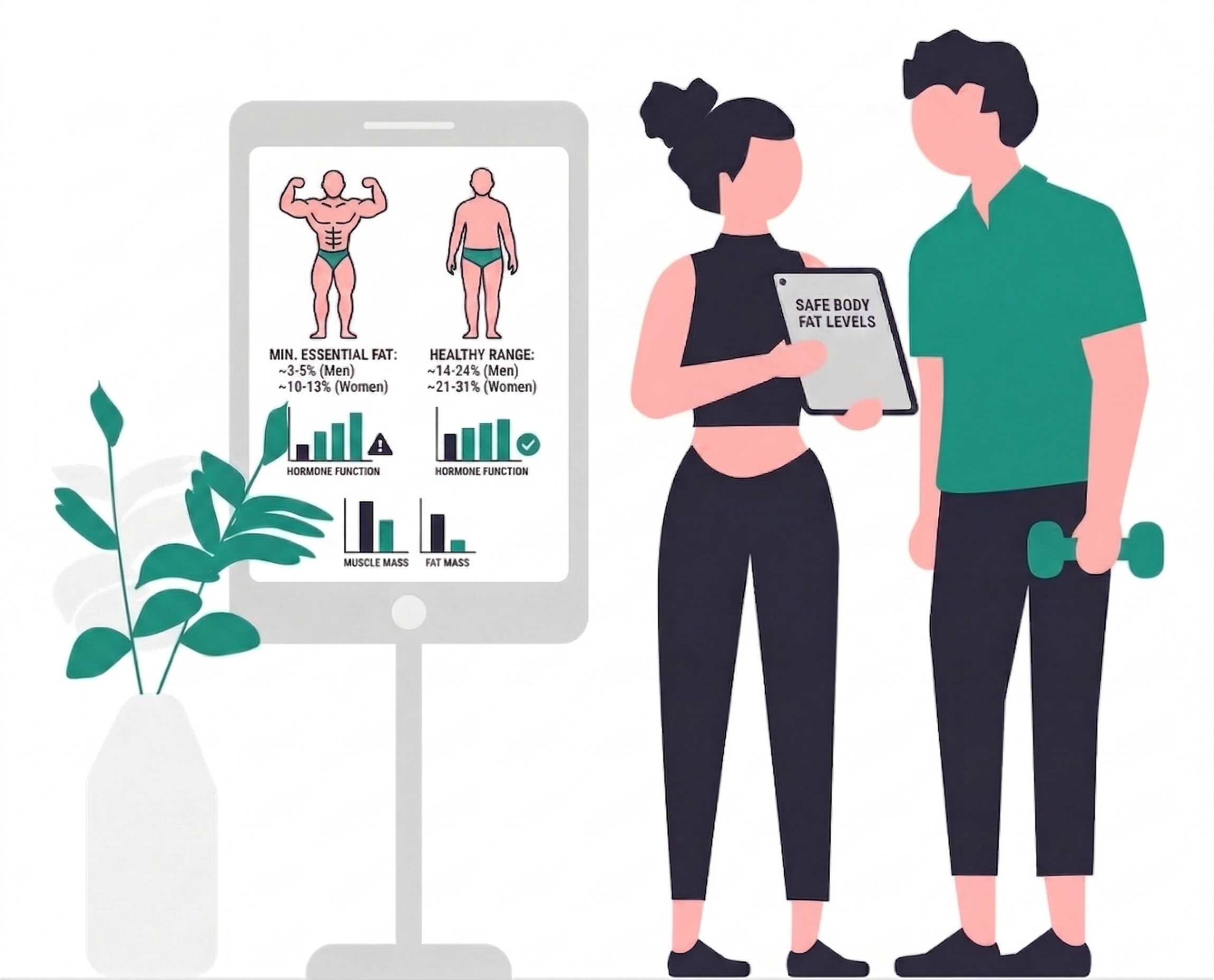
True 0% body fat is physiologically impossible. The human body requires essential fat for organ protection, nervous system insulation, hormone production, and cell membrane structure. The brain alone is approximately 60% fat by weight. Essential fat for men is 2-5% and for women is 10-13%[2]. When someone is reported to have "0% body fat," it means they had no measurable subcutaneous fat (the fat under the skin), not that they had zero total body fat.
Dropping below essential fat levels causes serious health problems:
- Hormonal collapse. Testosterone drops significantly in men. Women lose menstrual function (amenorrhea). Both sexes experience reduced thyroid output.
- Immune suppression. The body becomes more susceptible to illness and infection.
- Bone density loss. Chronically low body fat, especially in women, accelerates bone mineral loss and increases fracture risk.
- Organ damage. In extreme cases like Munzer, prolonged very low body fat combined with substances can lead to liver and kidney failure.
- Cognitive impairment and chronic fatigue. The brain relies on fat for structure, and the body downregulates metabolism to conserve energy.
Most health professionals recommend men stay above 6-8% and women above 14-16% for long-term health. If you are interested in lowering your body fat safely, see our evidence-based guide to lowering body fat percentage.
Health Risks of Extremely High Body Fat
Extremely high body fat is associated with severe, life-threatening health complications:
- Cardiovascular disease. The heart must work significantly harder to pump blood through a larger body, increasing risk of heart failure.
- Type 2 diabetes. Excess fat disrupts insulin signaling, leading to chronic high blood sugar.
- Sleep apnea. Fat deposits around the airway restrict breathing during sleep.
- Joint damage. Excess weight places extreme stress on joints, particularly knees and hips.
- Reduced mobility. At very high body fat levels, basic movement becomes difficult, which accelerates further weight gain.
- Shortened lifespan. Severe obesity is associated with a significantly reduced life expectancy.
What Body Fat Percentage Is Actually Safe?
The American Council on Exercise (ACE) provides the most widely used reference ranges[2]. For most people, the healthy and sustainable range falls between these extremes:
| Category | Men | Women |
|---|---|---|
| Essential Fat | 2-5% | 10-13% |
| Athletes | 6-13% | 14-20% |
| Fitness | 14-17% | 21-24% |
| Average | 18-24% | 25-31% |
| Obese | 25%+ | 32%+ |
Use our free body fat percentage calculator to see where you currently fall, and check the body fat percentage chart for a visual breakdown of each category.
Frequently Asked Questions
Sources
- [1]Andreas Munzer. Wikipedia. Includes autopsy details and career history.
- [2]American Council on Exercise (ACE). ACE Personal Trainer Manual. ACE, San Diego, CA.
- [3]World's first person to maintain less than 4% body fat for 100 days naturally: Guk Young Lee. Academy of World Records, 2018.
- [4]Helmut Strebl Profile. Greatest Physiques.
- [5]Jon Brower Minnoch. Wikipedia. Heaviest person ever recorded.
Related Resources
- Body fat percentage calculator — Find out your body fat percentage using the free Navy method.
- Body fat percentage chart — Visual reference for ACE categories and ideal ranges by age.
- What body fat percentage to see abs — The exact thresholds for visible abs without going to extremes.
- How to lower body fat percentage — Evidence-based guide to lowering body fat safely.
- How to measure body fat percentage — Compare 5 methods by accuracy, cost, and convenience.